
Still life photography ideas: 20 ideas to try at home
You don’t need a studio. A window, a dark background and a few objects from your kitchen are enough to make photographs that feel like small paintings. Here are twenty ideas, from easy to ambitious.
By Sander van Laar, Dutch artist making flower still lifes in the tradition of the Old Masters.
Before you start: a simple set-up
Every idea below works with the same basic set-up. Put a small table next to a window, ideally one without direct sunlight. Place a dark background behind it: a sheet of black card, a piece of velvet or a painted board. Turn off the room lights so the window is your only light source. Put a white card on the shadow side to bounce a little light back.
That’s it. One soft light from the side, a calm background and a low camera position are what make a still life look rich instead of flat. If you want to understand why, read my guide to still life composition and lighting.
Ideas 1–7: easy still lifes with everyday objects
1. One object, one light
Start with a single egg, pear or cup. Move it around until the light gives it a bright side, a soft middle and a deep shadow. This exercise teaches you more about light than any tutorial.
2. Three objects of different heights
A bottle, a glass and a lemon. Group them in a loose triangle, slightly overlapping. Odd numbers almost always look more natural than even ones.
3. Bread and a knife
A broken loaf, a few crumbs and an old knife. Texture is everything here, so let the light skim across the crust from the side.
4. Glass and water
Fill a few glasses with water and place them against a dark background, lit from behind or from the side. Watch how the edges start to glow.
5. Kitchen tools
Copper pans, wooden spoons, a whisk. Arrange them as if someone just stopped cooking. A little disorder tells a story.
6. Monochrome still life
Choose objects in one colour family: all white ceramics, or everything in shades of brown. A limited palette instantly looks more refined.
7. Books and a candle
Stack a few old books, add a candle and a pair of glasses. Shoot it in the evening with the candle as a second, warm light.

Ideas 8–13: flowers and fruit
8. A single flower in a bottle
One tulip or rose in a simple glass bottle. Let the stem lean, and give the flower space to breathe in the frame.
9. Fading flowers
Don’t throw your bouquet away. Wilting petals, curling leaves and fallen blossoms are often more beautiful than fresh ones, and they carry the classic message of transience.
10. Fruit bowl, Old Master style
Grapes, a peeled lemon with the skin spiralling over the table edge, a halved pomegranate. Let one piece of fruit hang over the edge of the table: it pulls the viewer into the picture.
11. Flowers with insects
Add a (dead or artificial) butterfly, snail or bee. In seventeenth-century paintings these small creatures symbolise the passing of time.
12. One colour, many flowers
Make a bouquet in a single colour, such as all white or all deep red, and photograph it against black. The shapes become the subject.
13. Flowers from above
Lay petals, leaves and flower heads on a dark surface and shoot straight down. A flat lay is an easy way to play with pattern and rhythm.
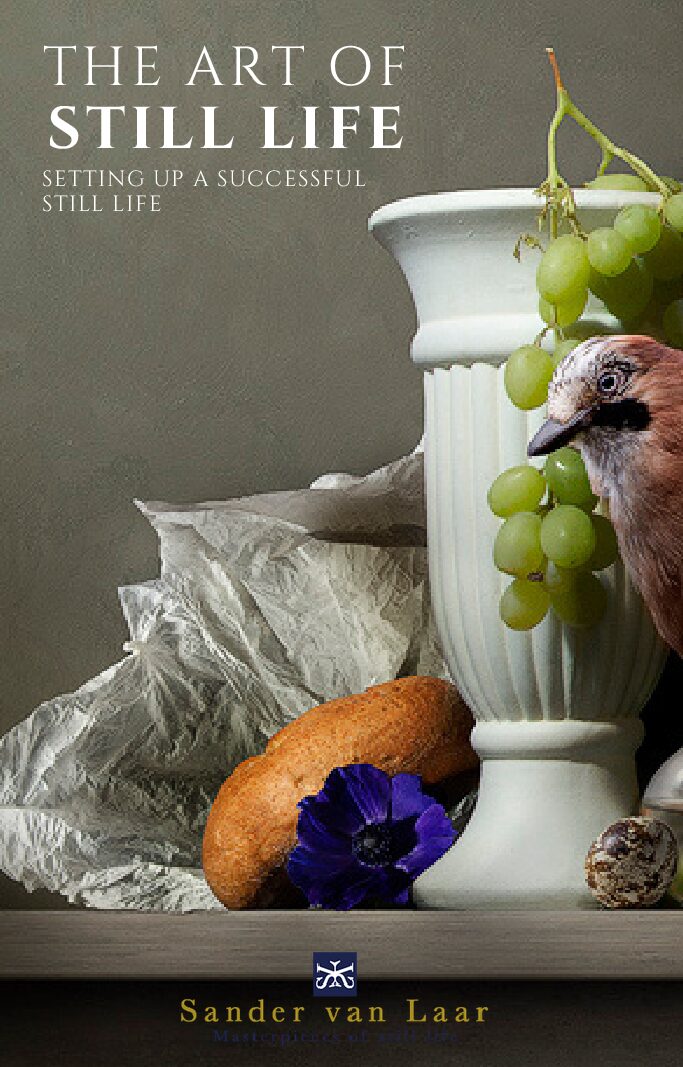
The Art of Still Life
Want to go deeper? My e-book explains composition, lighting, colour and Dutch Golden Age symbolism step by step, with ideas and exercises for beginners.
Discover the e-book · €24.99Ideas 14–20: inspired by the Dutch Golden Age
14. The breakfast piece
Painters like Willem Claesz. Heda made “breakfast pieces”: a pewter plate, a half-eaten pie, an overturned glass. Recreate one with what’s on your table after breakfast.
15. Vanitas
An hourglass or watch, a burnt-out candle, a book and a fading flower. A vanitas reminds us that life is short, and it’s a wonderful exercise in symbolism.
16. The impossible bouquet
Golden Age flower painters combined flowers that bloom in different seasons. Do the same over several days: photograph your arrangement in parts and combine the best flowers in editing.
17. The niche
Place a bouquet in a stone or wooden niche, or build one from two boards. It frames the flowers and adds depth, just like in paintings by Ambrosius Bosschaert.
18. Chiaroscuro
Block most of your window with dark card so only a narrow strip of light falls on the subject. The deep shadows create the drama of a Caravaggio-like painting.
19. Copy a masterpiece
Choose a painting you love, for example from my list of 10 Dutch Golden Age flower paintings, and try to recreate the light and composition with your own objects. You’ll learn how the masters thought.
20. Your own still life series
Pick one theme, one background and one light, and make five photographs that belong together. A series is where your personal style starts to appear.

Five tips that make every idea better
- Lower your camera. Shoot at table height or just above it. Looking down at a still life makes it look like a product photo.
- Use one light. Two light sources create double shadows and confusion. Keep it simple.
- Leave space. Empty, dark space around your objects gives them weight and calm.
- Look at the edges. Before you press the shutter, check all four corners of the frame for distractions.
- Edit gently. Darken the background a little, add warmth, and stop before it looks artificial.
Frequently asked questions
What do I need to start still life photography?
A camera or a good smartphone, a window with soft daylight, a plain background such as a sheet of dark card or fabric, and a few objects you like. A tripod helps, but a stack of books works too.
What are good objects for a still life photo?
Flowers, fruit, bread, glassware, ceramics, old books, shells, candles and kitchen tools all work well. Choose objects with interesting textures and shapes, and keep the colour palette limited.
Can I do still life photography with a phone?
Yes. Lighting and composition matter far more than the camera. Lock focus and exposure, avoid the built-in flash, and shoot near a window.
Learn to see like a still life artist
These ideas are a starting point. In The Art of Still Life I share how I build my own flower still lifes, from the first object on the table to the final print.