Dutch Golden Age · Flower still life

Dutch Golden Age flower paintings: 10 masterpieces

Flamed tulips, roses heavy with dew and glass vases that reflect the studio window. Seven flower still lifes from the Dutch Golden Age and three 19th-century heirs, and why they still captivate us today.

Nederlands? Lees de Top 10 bloemenschilderijen van de Gouden Eeuw.

Why flowers?

A bouquet that could never exist

In the 17th century, flowers were luxury goods. Tulips, especially, became objects of wild speculation, and a painted bouquet was a way to own blooms you could never keep in a vase. Many of these arrangements are in fact impossible: painters combined spring tulips with summer roses, working from studies made over many months.

Behind the beauty there is often a message. A fading petal, a fly or a pocket watch reminds the viewer that all beauty is fleeting, the classic vanitas theme. Look closely and every flower still life tells a story.

Flower still life with roses by Elias van den Broeck
01
Elias van den Broeck · c. 1670–1708

Flower still life with roses

Van den Broeck had a gift for capturing the fragile beauty of roses: petals that seem to curl and soften as you look at them. He is said to have trained with Jan Davidsz. de Heem, and you can see the master’s influence in the way light falls across every bloom.

Still life with flowers and a watch by Abraham Mignon
02
Abraham Mignon · c. 1660–1679

Still life with flowers and a watch

Mignon, another pupil of De Heem, was known for his refined, jewel-like still lifes. The pocket watch tucked into this bouquet is no accident: it symbolises the passing of time, a textbook vanitas motif hidden among the flowers.

Still life with flowers by Balthasar van der Ast
03
Balthasar van der Ast · c. 1625–1630

Still life with flowers

Van der Ast loved to place shells, insects and lizards beside his bouquets. Every detail is painted with almost scientific precision, and every creature carries meaning, from the short-lived butterfly to the fly that hints at decay.

Contemporary flower still life by Sander van Laar, inspired by Balthasar van der Ast
The same precision, today

A photographic still life in the spirit of Van der Ast

Like Van der Ast, I work with light, detail and symbolism. The difference: I capture it with my camera. That is how I translate the Old Masters to the present.

See my flower still lifes
Still life with flowers by Eelke Jelles Eelkema
04
Eelke Jelles Eelkema · 1815–1839

Still life with flowers

Two centuries after the Golden Age, the Frisian painter Eelkema kept the tradition alive. His bouquets have the same lush abundance, painted with a delicate, almost porcelain-like finish. His work is part of the Rijksmuseum collection.

Still life with flowers by Hans Bollongier, 1639
05
Hans Bollongier · 1639

Still life with flowers

Painted in Haarlem just two years after the tulip market crashed, this bouquet is crowned by striped, flamed tulips, the most coveted flowers of the age. Strong contrast between light and dark makes the blooms almost leap off the canvas.

Still life with flowers in a Greek vase by Georgius van Os
06
Georgius van Os · 1817

Still life with flowers in a Greek vase

Van Os also worked as a porcelain painter, and it shows: crisp outlines, luminous colour and a classical vase that gives the composition a calm, monumental base. A beautiful bridge between the Golden Age and 19th-century taste.

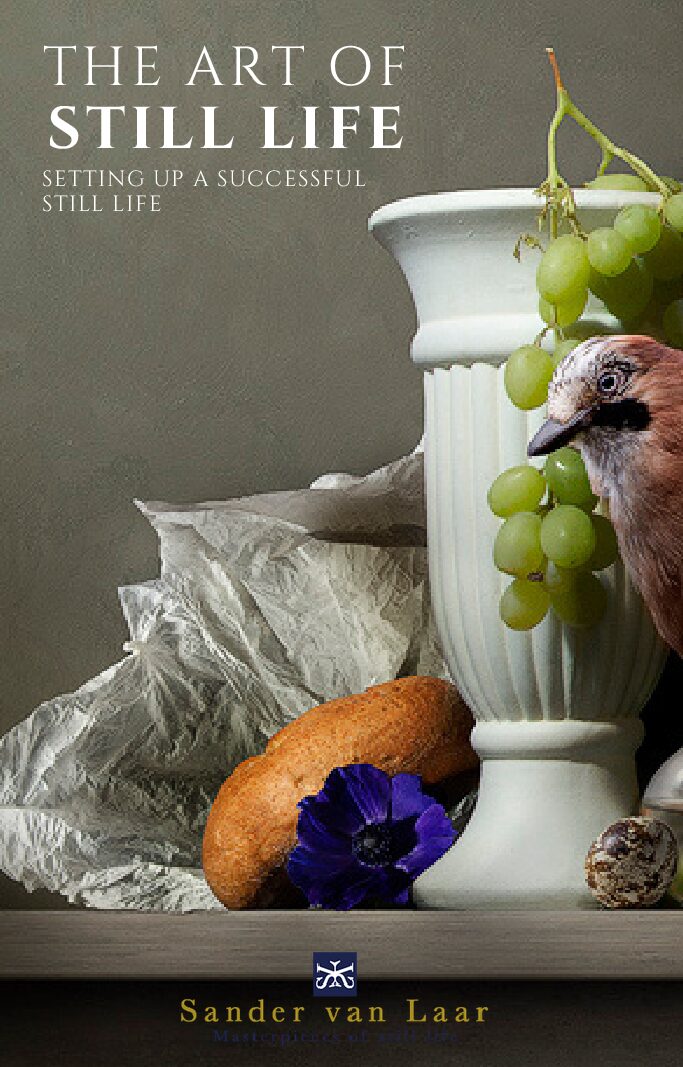
Cover of the e-book The Art of Still Life by Sander van Laar
Make your own

Learn to build a still life like the masters

My e-book The Art of Still Life shows you, step by step, how to compose, light and give meaning to your first still life, with objects you already have at home.

Discover the e-book
Still life with flowers in a glass vase by Jan Davidsz. de Heem
07
Jan Davidsz. de Heem · c. 1650–1683

Flowers in a glass vase

De Heem is often seen as the great teacher of the genre. Look at the glass vase: you can see the reflection of a window in it. His skill at painting glass, dew drops and the texture of petals remained unmatched for generations.

Festoon of fruit and flowers by Jan Davidsz. de Heem
08
Jan Davidsz. de Heem · c. 1660–1670

Festoon of fruit and flowers

Besides his vase paintings, De Heem made exuberant festoons: garlands of fruit and flowers that celebrate the abundance of the Golden Age, down to every drop of water and every leaf.

Still life with flowers in a glass vase by Rachel Ruysch
09
Rachel Ruysch · c. 1690–1720

Flower still life in a glass vase

Rachel Ruysch was one of the most celebrated flower painters of her time, and her paintings fetched prices far above those of many male contemporaries. Her bouquets swirl in elegant S-curves, full of movement, insects and sparkling light.

Still life with fruit and flowers by Eelke Jelles Eelkema
10
Eelke Jelles Eelkema · 1815–1830

Fruit and flowers

We end with Eelkema again: a rich arrangement of detailed fruit and flowers, set against a painting in the background. A small masterclass in composition and colour harmony.

How to look at a Dutch flower still life

Follow the light

Almost every painting has one light source, usually from the upper left. It sculpts the petals and leads your eye to the brightest flower.

Find the line

Many bouquets are built on a diagonal or an elegant S-curve. Trace it with your finger and the whole composition suddenly makes sense.

Spot the impossible

Look for flowers that bloom in different seasons side by side. The bouquet is an idealised collection, not a snapshot.

Read the symbols

Butterflies, flies, snails, wilting leaves and watches all speak of time and transience. They are the painting’s quiet message.

The tradition continues

Flower still lifes in the spirit of the Old Masters

Rachel Ruysch sold her work to the elite of her time. Today I make contemporary flower still lifes with the same love for light, detail and transience, available as fine art prints and on acrylic glass.

Want to make your own? Try these still life photography ideas and learn the basics of still life composition.

Images of historical paintings: public domain, Rijksmuseum Amsterdam.